Pacific Northwest winters bring prolonged dampness that promotes condensation inside metal ducts and furnace cabinets, especially in homes built on the slopes near Scouter Mountain Nature Park. Older stock around Happy Valley Town Center often has unsealed joints and flex runs that trap moisture and fine silt carried in from nearby Portland construction dust. Mild summers reduce airflow demand but leave residue from spring pollen that settles in return plenums. Cleaning must address both the furnace heat exchanger fins and the full trunk lines to prevent re-circulation when the first cold snap hits.
Clackamas County homes frequently combine forced-air furnaces with crawlspace or attic ducts that sit close to soil moisture. This setup creates edge cases where negative pressure from the blower pulls in ground-level humidity, accelerating rust on older galvanized sections. Technicians check for disconnected boots behind drywall in Scouter Mountain developments and use rotating brushes sized for 6-inch to 14-inch trunks common in the area. Skipping these steps leaves hidden buildup that reappears within one heating season.
Local building practices in Happy Valley often place returns in laundry rooms or garages where dryer lint and vehicle exhaust can enter the system. Furnace and duct cleaning here includes verifying that the evaporator coil—if present—is clear of the same winter grit that coats outdoor coils in nearby Clackamas neighborhoods. Proper containment during cleaning prevents cross-contamination between living spaces and the furnace closet, a detail that matters when windows stay closed for months.
Technician insight
In Happy Valley the thing that catches most people out with furnace and duct cleaning is crawlspace ducts sitting inches above wet soil during our long winters. Homes near Scouter Mountain Nature Park often have flex runs that sag and trap condensation, so the first sign is musty air when the furnace kicks on in October. Skipping the crawlspace inspection means the job has to be redone within a year.
Disconnected Return in Happy Valley Town Center Home
Homeowner noticed weak airflow and a dusty smell after the first cold snap. Inspection found a return boot pulled loose behind a closet wall in a 1990s house near Happy Valley Park. Crew reattached the boot, cleaned the full trunk line and furnace, then verified balanced airflow. The musty odor disappeared and the system ran quietly through the rest of winter.
How it works
- 1
Initial System Inspection
Technician maps all accessible trunks, returns, and the furnace cabinet while noting moisture stains or disconnected sections common in Happy Valley crawlspaces.
- 2
Access Point Setup
Create entry points at the main trunk and each branch without cutting drywall, using existing registers where possible in Scouter Mountain homes.
- 3
Negative-Pressure Cleaning
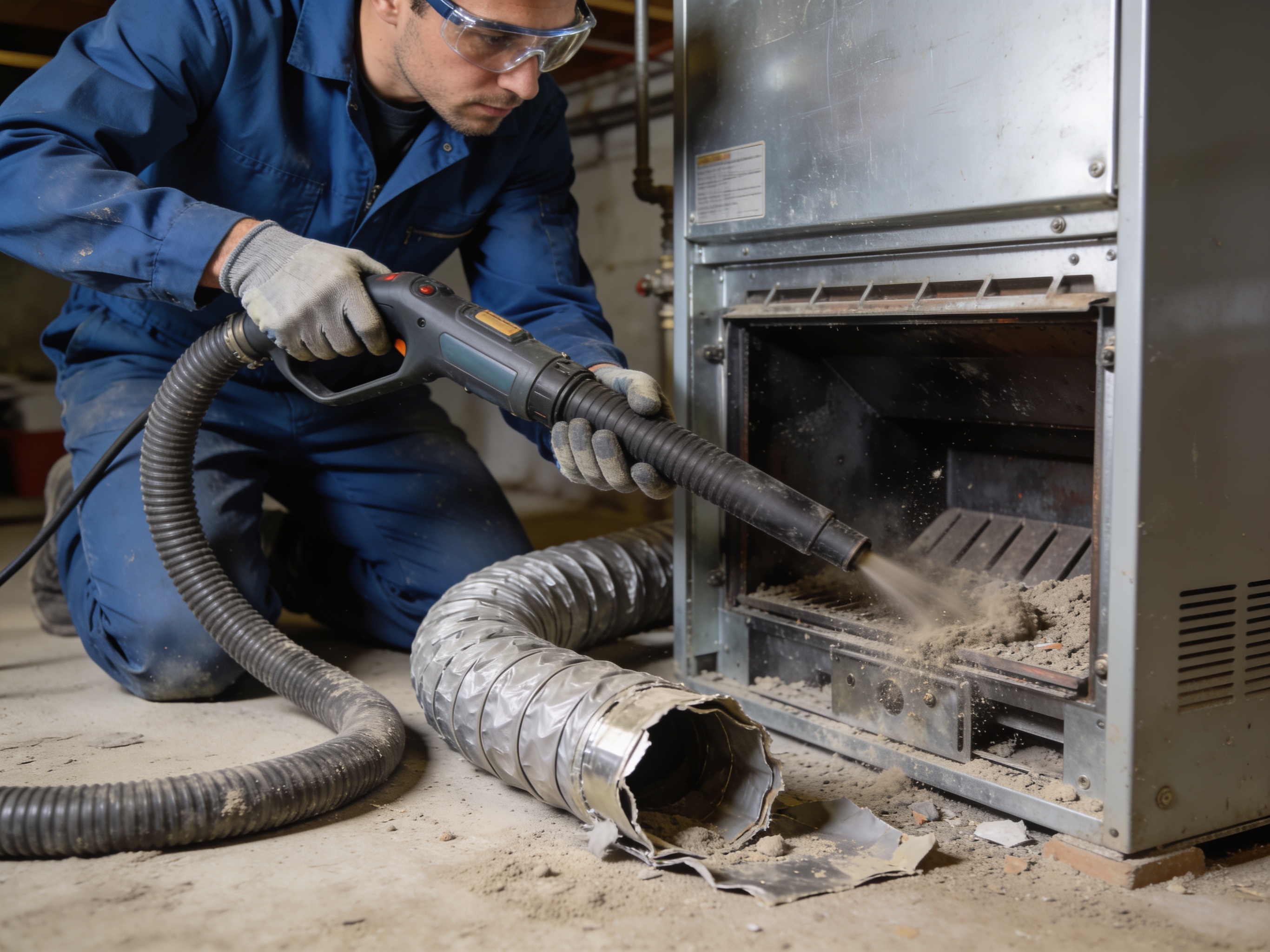
Run HEPA vacuum on the entire system while agitating ducts with brushes sized for local 6- to 14-inch lines, removing winter silt and pollen.
- 4
Furnace Component Cleaning
Clean blower wheel, heat exchanger surfaces, and return plenum, checking for rust caused by repeated damp winters.
- 5
Final Verification
Reassemble, test airflow, and confirm no debris remains before restoring full operation.
Pricing
Upfront quotes after inspection; price moves with number of trunk lines, crawlspace access, and any disconnected sections found in older Happy Valley stock.