
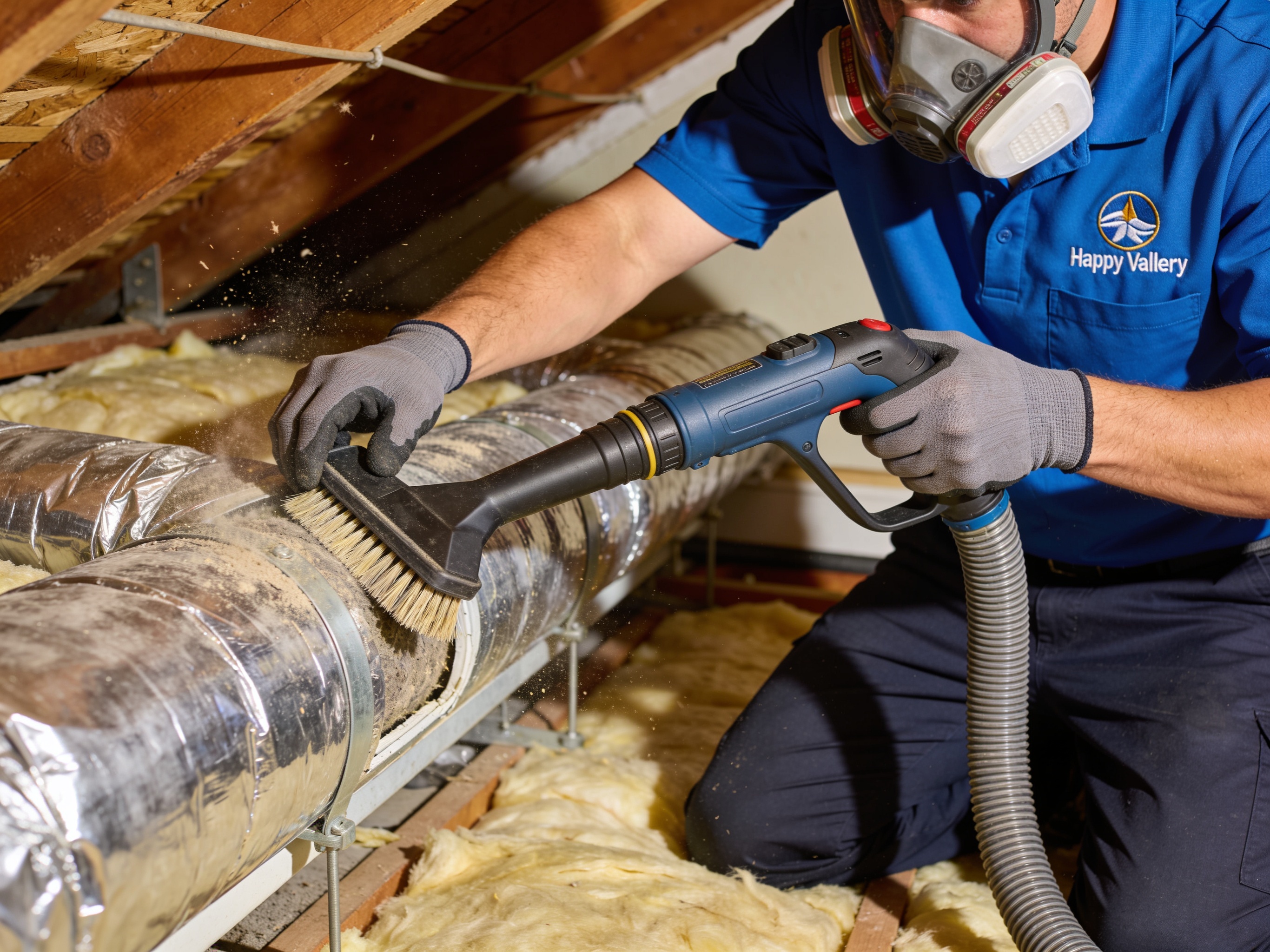
Happy Valley homes near Happy Valley Town Center and Scouter Mountain often feature duct systems installed during the 1990s and early 2000s expansions. These runs frequently sit in crawl spaces or attics where the Pacific Northwest's wet winters drive condensation along metal seams. Over time that moisture mixes with fine silt from nearby trails at Scouter Mountain Nature Park and pollen carried in from Portland, creating sticky layers that restrict airflow and feed mold colonies. Standard household filters miss the deeper trunk lines and branch runs, so residents notice uneven heating, musty odors when the system kicks on after a long rain, and higher energy use once summer cooling begins.
Technicians working these neighborhoods know to start with a full camera inspection before any negative-air machine is attached. Older flex duct sections common around Clackamas can tear under aggressive brushing, while rigid metal trunks near Happy Valley Park require different agitation tools to avoid denting. Wet winters also mean crews check for standing water in condensate pans that can back up into the return plenum, a problem less common in drier climates. Skipping these steps leaves hidden debris that reactivates within one or two seasons of mild summer weather.
Service calls in this area routinely include sealing accessible gaps with mastic rather than tape, because tape fails quickly in the humidity swings between winter rains and occasional summer heat. Homeowners along SE 172nd Avenue often request same-day scheduling when family members start coughing after the furnace runs following a storm. The 24/7 line at 13203 SE 172nd Ave, Suite 160 lets crews respond before moisture sets up new growth in the ducts.
Technician insight
In Happy Valley the thing that catches most people out with Residential Air Duct Cleaning is how wet winters push moisture into crawl-space ducts around Scouter Mountain. Homeowners assume a quick vacuum will handle it, yet the combination of condensation and pollen from nearby parks creates layers that only show up once the system runs after a long dry spell.
Scouter Mountain Home After Extended Rain
Residents near Scouter Mountain Nature Park reported persistent odors when the furnace started. Inspection revealed standing moisture in the return plenum from winter condensation. Crews extracted the debris, sealed the seams, and verified airflow improvement without disturbing the surrounding landscaping.
How it works
- 1
Initial Camera Inspection
Technicians run a scope through every accessible trunk and branch line to map buildup locations specific to Happy Valley homes.
- 2
Negative Air Setup
Equipment is staged at the exterior to pull debris outward while protecting interiors from the wet winters' typical dust load.
- 3
Agitation and Extraction
Whips and brushes loosen material without damaging older flex sections common near Scouter Mountain.
- 4
Final Sealing and Verification
Gaps are sealed with mastic and a second camera pass confirms clean lines before the system is returned to service.
Pricing
Cost depends on number of runs, access difficulty, and amount of debris; most Happy Valley jobs fall into a mid-range bracket that reflects the extra time required for older housing stock.