
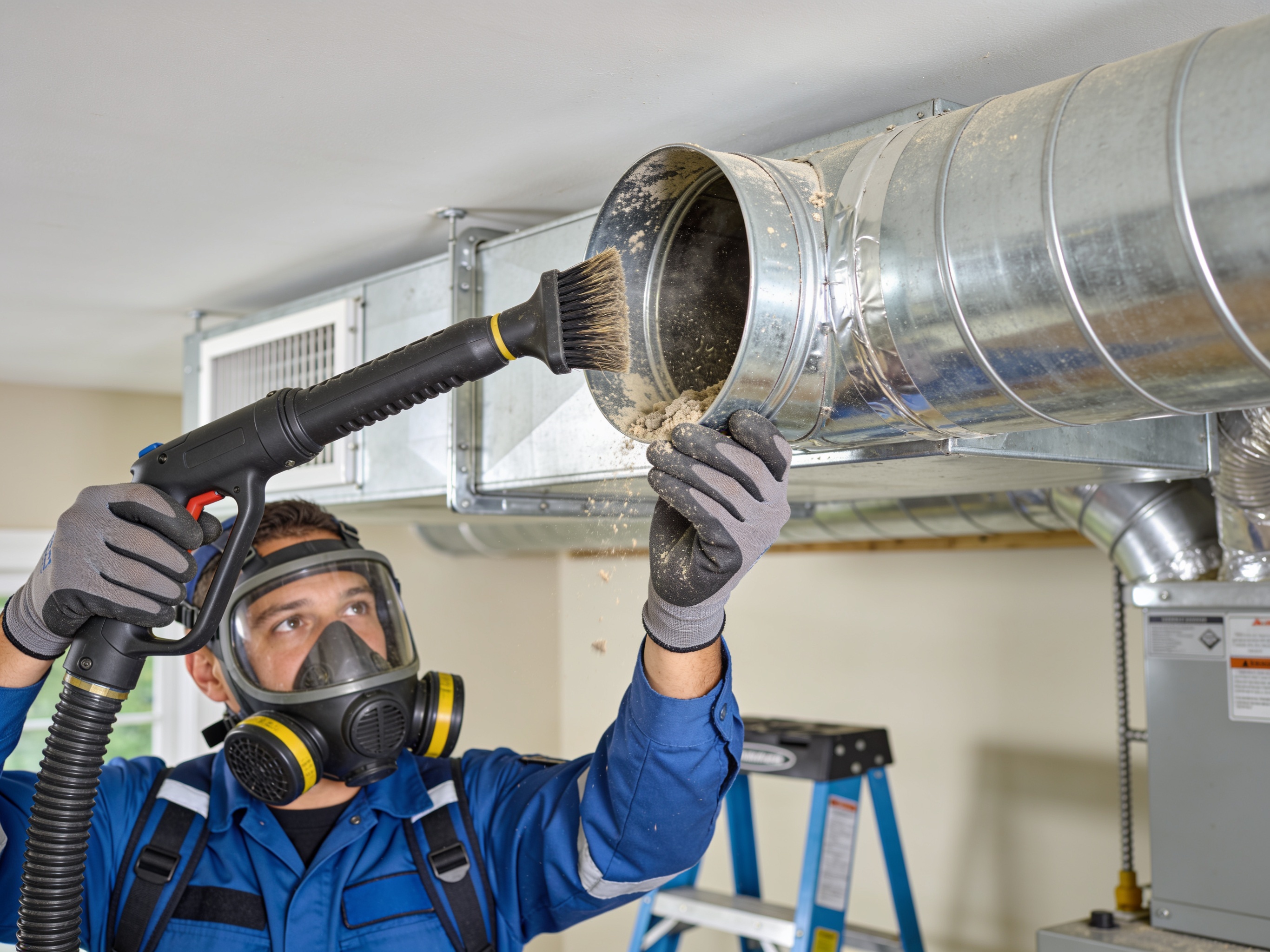
Happy Valley sits in Clackamas County where Pacific Northwest winters bring prolonged rain and mild summers keep systems running year-round. Homes near Happy Valley Town Center and Scouter Mountain Nature Park often have flex duct runs installed in the 1990s that trap moisture and fine silt carried in from nearby Portland. Left alone, that combination feeds mold colonies inside the main trunk lines and branch ducts feeding second-story bedrooms.
Technicians start at the furnace or air handler in the garage or crawl space, then work outward using negative-air machines rated for residential loads. In Scouter Mountain neighborhoods the terrain slopes, so return ducts frequently sit lower and collect standing condensation during the wet season. We isolate each run, agitate with forward-spinning brushes sized to the duct diameter, and extract debris without pushing material into the living space.
After cleaning we inspect the evaporator coil and blower wheel for the gray film that builds from Clackamas County pollen and fireplace soot. Homeowners along SE 172nd Ave commonly report improved airflow once the return plenums are cleared, especially in two-story houses where the upper registers had been starved. We finish by resetting the system and showing the homeowner the removed material so they can see exactly what left the ducts.
Technician insight
In Happy Valley the thing that catches most people out with HVAC duct cleaning is how the wet winters push condensation into the lower return ducts of 1990s homes around Scouter Mountain Nature Park. Those runs sit in cooler crawl spaces and collect silt that hardens by spring, so a standard vacuum-only job leaves the compacted layer behind and airflow barely improves.
Scouter Mountain Two-Story Return Lines
A homeowner near Scouter Mountain Nature Park noticed weak airflow from upstairs registers after the long rainy season. We found compacted silt and light mold inside the main return trunk that ran under the first floor. Negative-air cleaning plus targeted brush work on the lower flex sections restored pressure; the family reported the upstairs rooms finally matched the downstairs temperature within a day.
How it works
- 1
System Assessment
We map every accessible supply and return run from the air handler, noting flex duct sections common in Happy Valley homes built after 1995.
- 2
Isolation and Containment
Registers are sealed and a negative-air machine is attached at the main trunk to prevent dust migration into living areas near Happy Valley Park.
- 3
Mechanical Cleaning
Forward and reverse brushes sized to each duct diameter loosen debris while the vacuum pulls material out, critical after wet winters when silt has compacted.
- 4
Coil and Blower Service
Evaporator coil and blower wheel are cleaned on site so the restored airflow is not immediately re-contaminated by existing equipment.
- 5
Final Verification
We run the system, check static pressure at the unit, and show the homeowner the collected material before restoring all registers.
Pricing
Cost depends on number of runs, access to the air handler, and whether flex duct sections need replacement; we provide an upfront quote after the initial walkthrough.