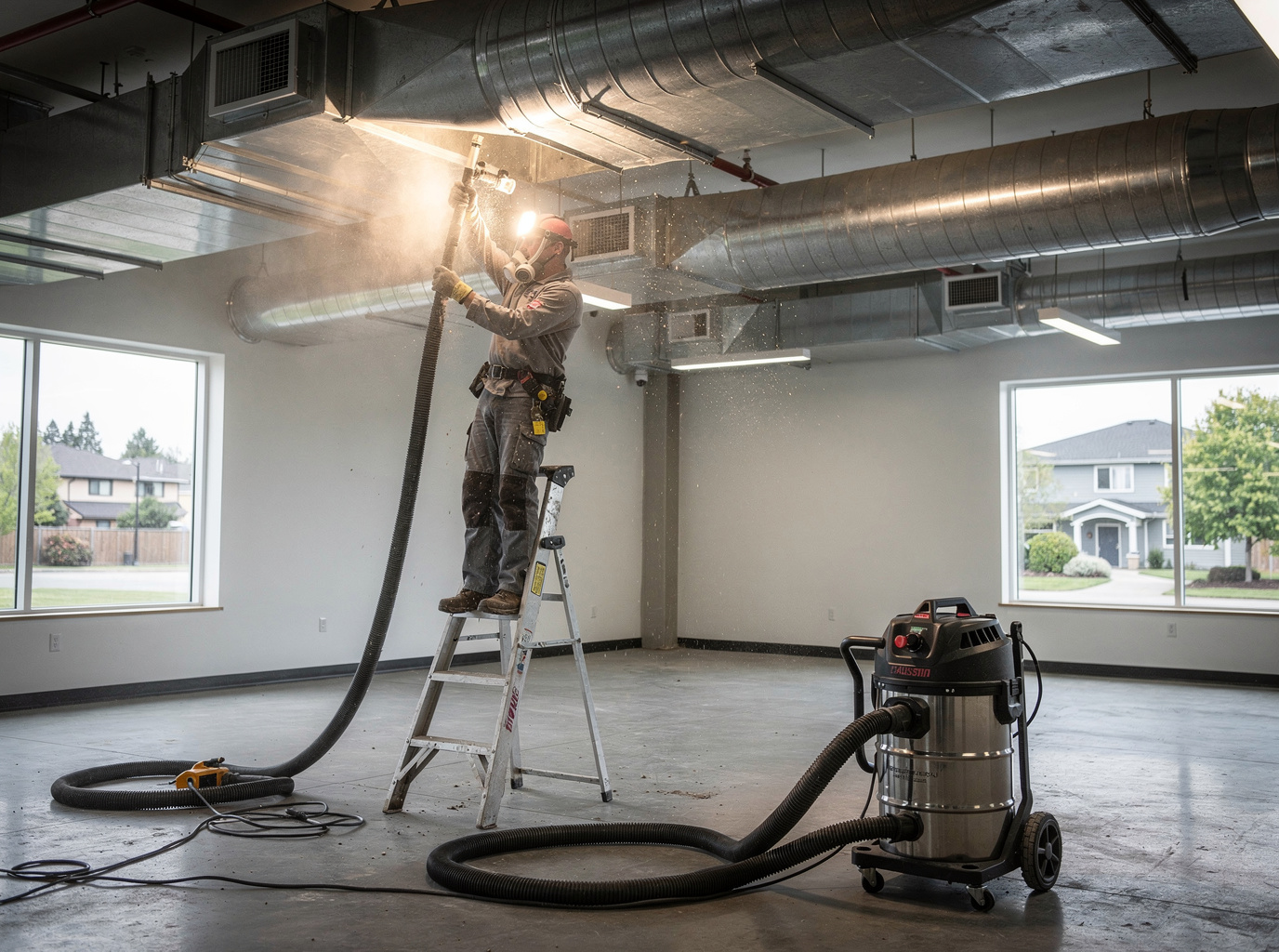
Industrial facilities in Happy Valley and nearby Clackamas often feature large metal duct runs serving warehouses and light manufacturing near Happy Valley Town Center. Pacific Northwest wet winters drive condensation inside these systems, especially where ducts pass through unconditioned spaces above Scouter Mountain. This moisture combines with dust from production processes to create buildup that restricts airflow and raises energy costs. Technicians must account for roof access challenges on single-story industrial structures and use negative-air machines sized for high cubic-foot volumes rather than residential equipment.
Older industrial stock around Clackamas and Portland corridors frequently includes lined ducts installed before current energy codes. The liner can delaminate over time, trapping contaminants that standard brushes miss. In these cases crews pull sections for inspection, then apply EPA-registered encapsulants only after source removal. Access ports must be cut and sealed to maintain fire ratings, and all work occurs without shutting down adjacent operations when possible.
Mild summers reduce thermal stress on equipment but allow pollen and outdoor particulates to infiltrate through rooftop intakes near Scouter Mountain Nature Park. Industrial cleaning therefore includes coil and plenum work in addition to main trunk lines. Crews document before-and-after static pressure readings so facility managers can verify restored performance without relying on visual claims alone.
Seasonal Considerations
Wet winters increase corrosion risk on galvanized ducts in unheated industrial spaces. Scheduling service after the rainy season allows full drying before sealing any liner repairs.
Technician insight
In Happy Valley, the thing that catches most people out with Industrial air duct cleaning is how wet winters push condensation into uninsulated ducts running through warehouses near Scouter Mountain, turning light dust into stubborn sludge that needs extra agitation passes.
Clackamas County Warehouse
A manufacturing warehouse near Happy Valley Town Center reported uneven airflow. Inspection revealed heavy buildup in main trunks fed by rooftop intakes exposed to Pacific Northwest pollen. Crews set up negative air, removed debris from all accessible lines, and resealed access points. Airflow readings returned to design specifications.
How it works
- 1
Site Assessment
Map all accessible trunk lines, branches, and rooftop units while noting access limitations typical of Happy Valley industrial parks.
- 2
Containment Setup
Install negative-air machines and sealed barriers to prevent cross-contamination into occupied production areas.
- 3
Source Removal
Agitate and extract debris using brushes and HEPA vacuums sized for commercial volumes.
- 4
Verification and Documentation
Measure post-clean static pressure and provide photos plus written report for facility records.
Pricing
Pricing based on system size, access difficulty, and number of rooftop units after on-site evaluation.